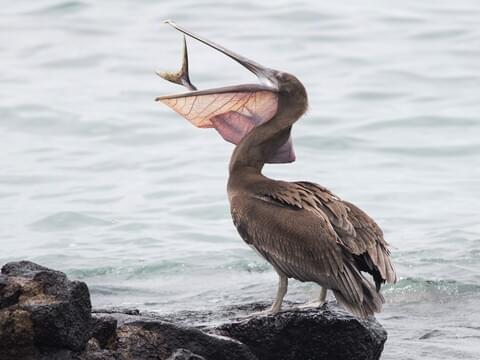
"...in the 1960s DDT caused populations of brown pelicans to go extinct in California, Louisiana, and several other regions of the US. After DDT was banned in the 1970s, individuals from surviving populations within the metapopulation began to recolonize the affected regions. Today the brown pelican is no longer listed as endangered."
I've always been a fan of pelicans since I grew up watching them on the beaches of South Florida. I really admire the way they glide just inches above the water when looking for fish, and the pouches in their bills are quite fascinating. I'm really glad DDT was banned in time for them to make a recovery, as beaches really just wouldn't be the same without them. I also never recognized that a species can become locally extinct, which makes sense since it's rare for every member of a species to be gathered in one area. I guess polar species are the only examples I could think of as examples. The word 'metapopulation' was also in bold as a vocabulary word, and it refers to a collection of local populations all working together so that they can't be wiped out in one fell swoop.
 |
| https://www.allaboutbirds.org/guide/Brown_Pelican/id |
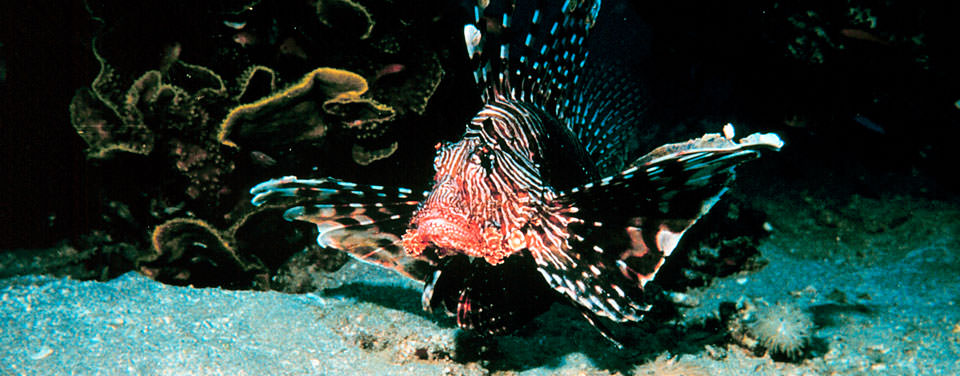
"Invasives are more efficient than the natives at exploiting nutrients and other resources, and without natural controls they can take over a habitat, driving some of the natives to extinction."
 |
| https://oceanservice.noaa.gov/facts/lionfish.html |
"However, “no net loss” is an improvement over earlier practices that failed to address ecosystem loss (Perlman and Milder 2004, 207). Mitigation does create a financial incentive to developers for restoring or enhancing wetlands, and the practice of mitigation banking does consolidate many small projects into larger, potentially more ecologically valuable sites."
I felt like this quote applied to me and what I want as a career in the future. While I don't plan on becoming a contractor and creating new developments, I will be getting into real estate investing which I believe will provide me with many chances to contribute to conservation efforts to offset development. I love wildlife of all kinds so I can say without a doubt that I will be navigating my future job with species conservation as a high priority. While the system in the quote isn't perfect, it's many times better than not trying to mitigate losses at all, which is what we used to do.
Sources:
- US Department of Commerce, & National Oceanic and Atmospheric Administration. (2013, June 1). Why are lionfish a threat to Atlantic Ocean fish? Retrieved from https://oceanservice.noaa.gov/facts/lionfish.html.
- Robertson, M. (2017). Sustainability Principles and Practice. Abingdon, Oxon: Routledge.

No comments:
Post a Comment