Sustainable Food
"Since the green revolution, food production in developing countries has increased, doubling or tripling in many places. However, because population has also nearly doubled, the amount of food produced per person has remained nearly unchanged in most parts of the world. At the same time, the green revolution has resulted in damage to soils, waters, and ecosystems, the final costs of which are not yet known."
Before reading this quote, I didn't fully understand the dilemma between increased food production and the increasing human population. The problem with world hunger is such that if we try to increase food production to resolve it, the world population increases because times are good, and it is easier to raise children with the surplus of food. Of course, then the increasing population begins to outpace food production and we are back to where we started. If we are going to solve world hunger, it is obviously going to take a more creative solution than just making more food. It is also a bad solution because our new and more effective methods of growing food are actually hurting the Earth and are not viable in the long run. We need new scientific breakthroughs in agriculture that avoid negatively impacting the environment.
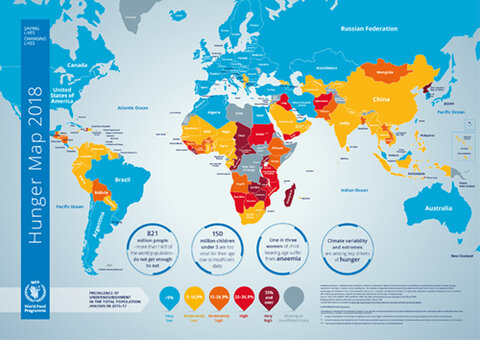 |
| https://www.wfp.org/publications/2018-hunger-map |
"Farmed fish are selectively bred for growth qualities and often genetically modified. When they escape from ponds and coastal pens into wild ecosystems, they grow larger and faster than native fish, whom they outcompete, while at the same time spreading disease and affecting the genetic pool by interbreeding."
I've been to a fish farm before in Minnesota that dealt mainly with salmon and the experience was both revealing and surprising. The tour they gave me of the facility didn't really give me the impression that it was too small for the fish, but then again, I wouldn't know how much space salmon really need. I was with my family and they gave us one of their salmon filets to take home. It was delicious, and as an experiment we went out and bought a wild-caught salmon to compare. It was amazing how different the taste was between the two, and it made me realize that we are getting accustomed to these genetic modifications in our food. The wild-caught salmon had much tougher flesh, less fat, and was also a darker color. This observation really made me think about what the future holds and whether this will be a positive or negative thing for both humans and the environment.
 |
| https://www.nanaimobulletin.com/news/john-horgan-wades-back-into-salmon-farms/ |
"About 70 percent of water use world-wide goes to the production of food (Sachs 2009, 36). Large-scale irrigation depletes underground aquifers such as the ancient Ogallala, while heavy use of irrigation water to grow crops on land that would not normally support them overtaxes some surface waters, such as the Colorado River in the US."
This statistic shocked me because it reminded me about how it takes 3,000 gallons of water just to make a pair of jeans. It really puts into perspective just how much water is used to make the things we use and eat every day. I've also never seen an aquifer before, and this quote makes me imagine a huge space underneath the Earth that spans across multiple states and would make a deep sea diver shake in his fins in order for it to be big enough to be able to supply us with that much water. We also need to figure out what we are going to do when these resources are finally depleted, and it should be sooner rather than later.
Sources:
Sources:
- Robertson, Margaret. Sustainability Principles and Practice. Routledge, 2017.

No comments:
Post a Comment