Energy
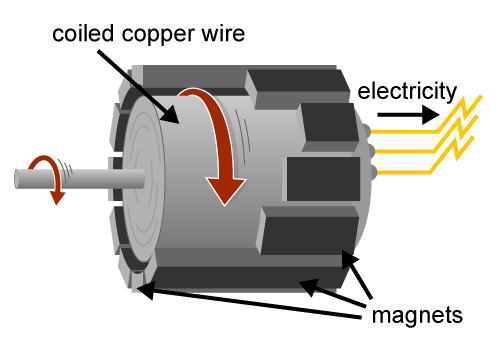
"Power plants use mechanical energy to turn generators. A generator is a device that converts mechanical energy into electrical energy. Mechanical input for generating electricity can come from a wind turbine, a turbine in a hydroelectric dam, ocean wave action, diesel engines, or a steam turbine. . . When a coil of wire in a generator rotates inside a strong magnetic field, the motion induces electrical current to flow in the coil."
I think this quote did a good job of explaining how generators create electricity, as it was a concept I had previously struggled with or maybe didn't care to really remember the first time it was explained to me. I've noticed that a lot of people today are content with not knowing how things work as long as they actually work. I believe this can be attributed to the rise of the era of specialization in the workplace and the need for people to be able to do one thing very well while sacrificing passable knowledge in other subject areas. Inventions have also become more and more complex as time has passed, and it has become harder in general to just understand how a complex piece of machinery such as a printer or a car works unless you work with them directly.
 |
| https://www.eia.gov/energyexplained/electricity/how-electricity-is-generated.php |
"Generating electricity from sunlight is not free. Although costs are coming down, the initial costs of installing a PV system remain high. Government subsidies will be essential until the solar industry comes up to scale. In Germany, government policy which guaranteed a long-term premium price and access to the grid led to rapid growth of solar power in that country (Brown 2015, 68)."
Maybe I'm biased, but as a strong capitalist and libertarian, seeing government subsidies being described as essential just makes me fume. To me, it seems like Margaret Robertson believes you can solve any problem just by throwing more money at it. Even worse, taxpayer money that comes from those that may not even agree with the plans for its use. Solar power is still nowhere near becoming a reliable source of energy, so it'd be hard to sell an expensive push in solar research to the average taxpayer. Sure, our current sources of energy are becoming increasingly less stable as time goes on, but that doesn't give anyone the right to steamroll over others in order to get what they believe is most important. Furthermore, the source Robertson uses isn't even entirely accurate. Yes, the presence of solar power in Germany has increased, but the way she frames it makes it seem like the government subsidies were successful and had no negative impact on the country. In reference to Germany's solar subsidies, Ball says, "But all that ambition is bleeding Germany. The mounting costs are testing its resolve. Leading politicians, even those with strong environmental credibility, are racing to rein in spending. If they can’t achieve that, then Germany’s near miracle may be remembered as the environmental equivalent of, say, heart-transplant surgery: a worthy endeavor, undoubtedly, but one that remains unattainable for all but the very wealthiest" (Ball) Even worse, he also quotes an actual German citizen that takes advantage of the subsidy who says, "If a business owner ran a company the way the German government has structured its solar subsidies, he would be bankrupt" (Ball).
 |
| https://www.forbes.com/sites/michaelshellenberger/2019/02/05/if-saving-the-climate-requires-making-energy-so-expensive-why-is-french-electricity-so-cheap/#3e6a43a1bd98 |
"So-called “traditional biomass” is wood, charcoal, agricultural residues, and animal dung burned for cooking and heating in developing countries. This material often comes from unsustainable harvesting and results in unhealthy air pollution, greenhouse gas emissions (IPCC 2014c, 48), and climate impacts from black carbon (OECD 2012, 135)."
I shouldn't have been eating while reading this quote, I almost couldn't finish my sandwich. It's hard to imagine someone that can stand the smell of burning animal dung and still be able to eat whatever they cooked afterwards. This is a great opportunity for us to band together and work towards a solution that doesn't require the help of the government and that we can feel personally proud of.

Sources:
Robertson, Margaret. Sustainability Principles and Practice. Routledge, 2017.
Ball, Jeffrey. “Germany's High-Priced Renewable Energy Revolution.” Fortune, Fortune, 14 Mar. 2017, https://fortune.com/2017/03/14/germany-renewable-clean-energy-solar/.

No comments:
Post a Comment