"Every day the average person living in the US throws away 4.6 pounds of solid waste (Center for Sustainable Systems Factsheets 2008, 1), and for every pound of household waste we discard, 40 to 70 additional pounds of industrial debris were generated during its production (Rogers 2005, 4). But as one of Barry Commoner’s “four laws of ecology” makes clear: “Everything must go somewhere. There is no ‘waste’ in nature and there is no ‘away’ to which things can be thrown” (Commoner 1971)."
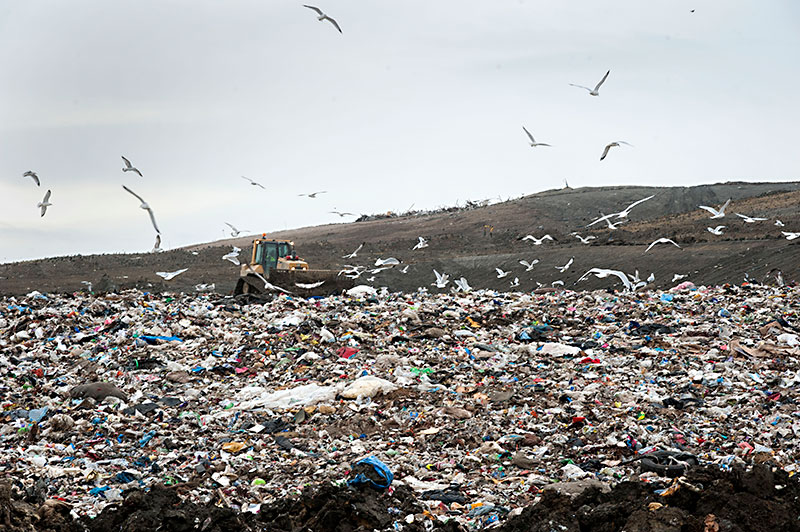
The problem of waste in today's society has truly become a problem bigger than any single person can understand at this point without getting a good lake at our waste management system. Since not many people have the time or the will to go out of their way to do this, the waste problem continues to escalate and cause even more harm to our planet. I believe one of the biggest contributors to this problem is the way we package things and the rules we have in place associated with it. I'm of the general opinion that lawyers can manage to ruin anything, and they've certainly done so with packaging. Lawsuits have led to the requirement of more packaging for the safety of the minority consumer that doesn't understand how to handle products safely, which in turn has created more waste that ends up being discarded in landfills. Landfills aren't even a good option for waste management as the quote describes, because landfills were areas that were originally vital parts of diverse ecosystems that was then designated as a waste site by humans.
 |
| https://www.austinchronicle.com/news/2019-01-18/austins-least-loved-landfill-may-be-poised-to-grow-again/ |
"Incineration produces ash in two locations: Bottom ash collects at the bottom of the combustion chamber; lighter-weight and more-toxic fly ash forms in flue gases in the stack. When scrubbers and filters are added to stacks to remove pollutants such as dioxins from flue gases, the pollutants do not disappear but are transferred from the exhaust gas to the fly ash as it collects in the filter media (ibid.). The contaminated ash is sent to a landfill, where dioxin and other toxins can become mobile in leachate and enter soil and groundwater (Rogers 2005, 5; Leonard 2010a, 214)."
I liked this quote because it reminds me just how far we've advanced in scientific knowledge, and it made me imagine how the early pioneers of these waste management systems must have felt creating what they thought to be an ingenious solution to a problem they had the foresight to recognize. Before science, people usually believed that if you could no longer see it, then it wasn't there anymore. We now know better and recognize the threat of microscopic toxins that are poisoning our environment, allowing us to act and conduct ourselves in a more responsible manner. One way we could combat the problem posed in the quote could be by using more sustainable resources in things such as packaging that don't release pollutants such as dioxins.
 |
| https://www.ecomaine.org/our-facility/waste-to-energy-plant/ |
"In the waste hierarchy known as the 3Rs, the priorities for dealing with waste are to reduce, then reuse, and finally recycle as the last line of defense. Some sustainability specialists recommend adding a fourth, higher priority, 're-think,' to the beginning of the hierarchy: re-think, reuse, reduce, recycle. They point out that we may be asking the wrong questions. Maybe the question should not be, 'how can we recycle more?' Maybe the right question is, 'how can we stop producing so much waste in the first place?'"
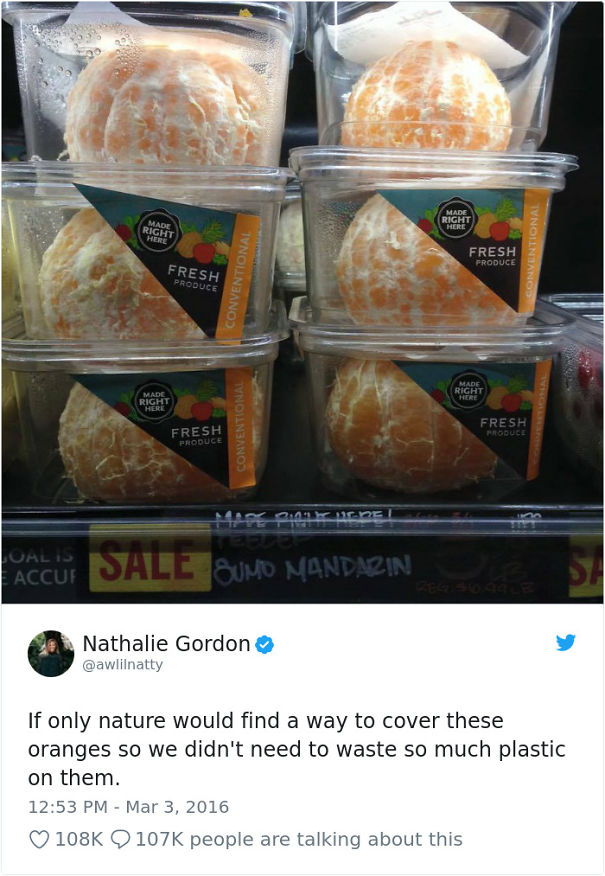
It looks like I already understand the concept of 're-think' pretty well given the example I gave in the first section of this blog. Using less packaging on products would drastically decrease the amount of waste created and would make it much easier to recycle the necessary waste conducive to every day life. I believe many people today have become too soft given the abundance of regulations that cater to the inept and indifferent. In my perfect world, these people would unfortunately fall victim to the natural selection process, allowing for the others to successfully manage their waste in a safe, competent, and environmentally-friendly manner, which would do wonders for the health of our planet.
 |
| https://www.boredpanda.com/unnecessary-wasteful-packaging/?utm_source=google&utm_medium=organic&utm_campaign=organic |
Sources:
Robertson, Margaret. Sustainability Principles and Practice. Routledge, 2017.

No comments:
Post a Comment